When the Body Says Stop: A Conversation on Mental Health, Boundaries, and the Art of Letting Go
Michelle PettiesMay is Mental Health Awareness Month — a designation that, for Black women navigating full-time careers, volunteer leadership, family obligations, and the unrelenting pressures of this political moment, can feel less like a calendar reminder and more like a mirror. A hard one.
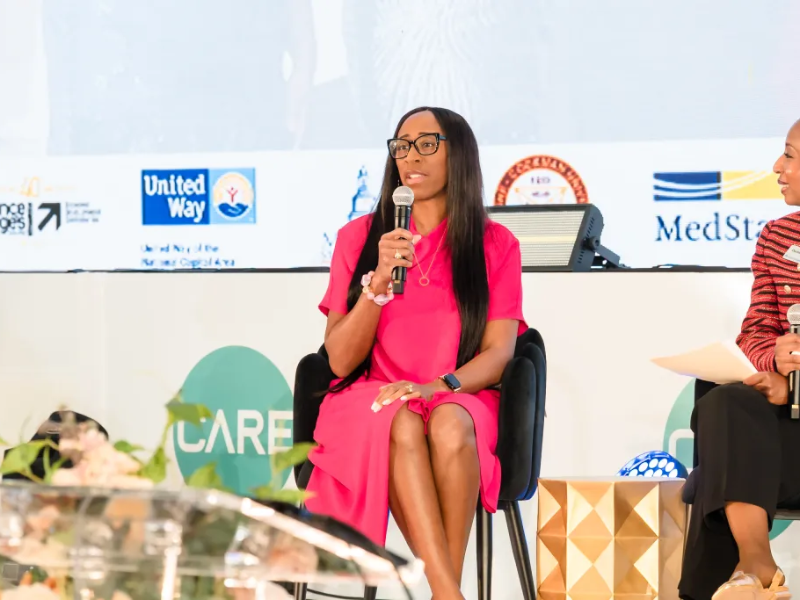
Awanya Anglin-Brodie knows what she sees in that mirror. As a Senior Account Executive at Urban One’s Radio One Baltimore — a company she’s called home for over 28 years — and as President of the Greater Baltimore Section of the National Council of Negro Women (NCNW), she operates, in her own words, with “two major hats.” One pays the mortgage. One doesn’t. Both demand everything she has.
“Both positions are very demanding,” she told me during a recent conversation. “One I get paid for, one I don’t. But the one that I…my non-profit side, because of the level and things that we’re doing, it is just as demanding. It’s technically like I’m doing another full-time job on top of that.”

She laughs when she says it. But the laughter carries weight.
The Superwoman Trap
Mental health researchers have long documented what they call the “Superwoman Schema” among Black women — an internalized pressure to appear strong, suppress emotions, resist help, and place others’ needs before their own. Anglin-Brodie doesn’t use the clinical term, but she lives its consequences every day.
“We fall prey to that superwoman stereotype,” she said. “We go down, the ship goes down — there’s no question about that. But we always feel like we have to be that person. If I don’t do it, then this is going to happen.”

The turning point came at the end of 2025, when three close friends died in rapid succession. The grief was disorienting. “I didn’t know my name,” she said quietly. “I didn’t know anything.” For the first time, her body issued an ultimatum: slow down, or I will slow you down myself.
She called an emergency meeting with her NCNW board. She explained the situation. She stepped back — not out, but back — for two weeks. She took time off work, disconnected from email entirely, and gave herself permission to cry, to scream, to simply be.
“I know that had I not done that,” she said, “something probably would have happened to me physically. I’ve learned to hear my body when it’s saying stop.”

Her Mother’s Warning
The urgency isn’t abstract for Anglin-Brodie. It’s ancestral. Her mother — heavy, a smoker, a drinker, physically inactive, and under chronic stress — died of a massive heart attack at 56. Anglin-Brodie turns 51 this month.
“At my age, she already had congestive heart failure,” she said. “And I’m blessed that I don’t have high blood pressure, because I’m able to step back and say, I don’t want to do this.”

She carries her mother’s story not as a sentence, but as a compass. The inherited wisdom is not the habits her mother kept, but the ones she didn’t. “I know what I came from. I know what I’m built of,” she said. “But I don’t practice the same habits.”
Boundaries as a Health Practice
For Mental Health Awareness Month, the conversation around self-care often skews toward individual acts — bubble baths, journaling, therapy. Anglin-Brodie’s approach is more structural. Boundaries, she has learned, are not luxuries. They are medicine.
She no longer brings work home. When she leaves the office, she is done. If something urgent requires extra time, she stays at work to finish it — so that when she walks through her front door, the threshold holds. “My home is truly a safe place,” she said. “It’s like church and state.”
On weekends, she protects at least one day of complete stillness. No calls. No obligations. Netflix, and solitude. Even her husband knows not to interrupt. She also rediscovered walking during COVID — not as exercise exactly, but as decompression. “You know, by the time you start running your mouth with a girlfriend, you don’t realize you’ve walked five miles,” she laughed. “But it clears your head.”
She also noted something she hadn’t expected: when she starts moving her body, her eating habits shift naturally. “When I walk and when I start to get more active, it’s like it clicks. My eating habits forcibly change. I’m not gonna walk and then go eat a Big Mac. It kind of works hand-in-hand.”
The Weight We Carry Together
Anglin-Brodie was candid about the particular weight Black women carry in this political and social moment. “As Black women, we’re working hard, we’re still not recognized. And people don’t understand that that’s a trauma you carry even in your day-to-day.”
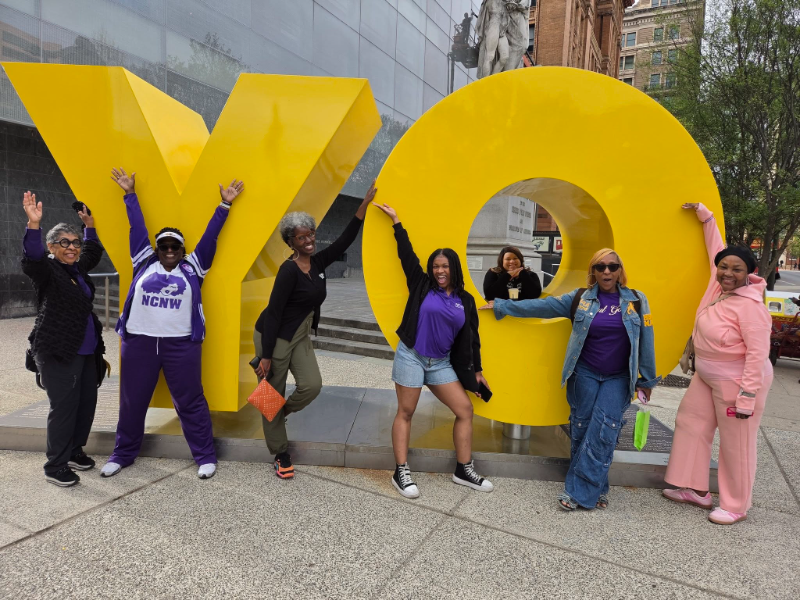
She doesn’t look away from the news, but she has built a practice of discernment: engage what she can influence, release what she cannot, and trust her village to hold her when the load gets too heavy. The NCNW empowerment work — including an upcoming resource fair on June 6th at Lexington Market, featuring health screenings, workforce development, and civic education — is how she channels that energy outward.
“We want to make sure that we build some infrastructure and support, and we empower and we educate,” she said. “So that we can power through this.”
This Mental Health Awareness Month, Awanya Anglin-Brodie’s message is not complicated: your body is telling you something. Are you listening? Setting a boundary is not weakness — it is a survival skill. Asking for help is not failure — it is wisdom. And stepping back, even briefly, is sometimes the most powerful thing a leader can do.
“I’ve learned,” she said simply, “just by setting those boundaries, I’ve been able to watch my stress level. And preserve me.”
The NCNW Greater Baltimore Section Empowerment Resource Fair takes place June 6th from 12–4 PM at Lexington Market, featuring health screenings, education, workforce development, and civic engagement resources. Free and open to the public.
Michelle Petties is a TEDx speaker, Food Story coach, and the award-winning memoirist of Leaving Large: The Stories of a Food Addict. After gaining and losing 700 pounds, Michelle discovered the secret to overcoming stress and emotional overeating. Her free workbook, Mind Over Meals, reveals her core principles for losing weight and keeping it off.